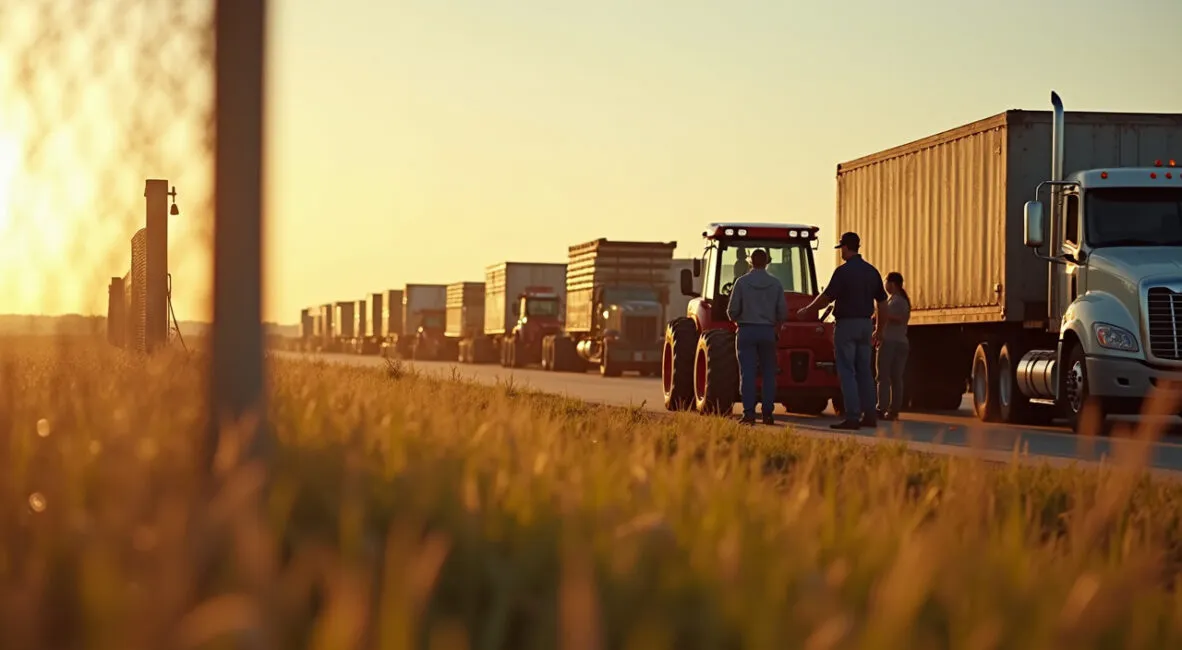
John Deere said on Thursday that it expects to reach about US$5 billion in revenue from its agricultural and construction segments by 2026, citing a sustained recovery in demand. The announcement came as the company’s shares rose as much as 13 percent during intraday trading, renewing a record not seen since March 2020.
Executives attributed the recovery to stronger global commodity prices, renewed investment by farmers in small and mid-sized equipment, and improving construction activity. “We are encouraged by the continued recovery in demand in both construction and small-acreage agriculture segments,” said a company spokesperson, signaling potential upside for margins and cash flow.
Stock Jumped 13% On Day of Forecast, Matching March 2020 Record
John Deere’s stock gained up to 13 percent on the day the company reiterated its growth plans, reaching price levels not seen since March 2020. Market participants reacted to management’s updated guidance and to signs of improving end-market demand in multiple regions.
Analysts noted that such a sharp intraday move reflects both optimism and repositioning by institutional investors. “The market priced in a clearer path to revenue growth, especially in areas where replacement cycles were delayed,” said Maria Torres, equity strategist at FirstGate Capital.
The price move also tightened the company’s valuation metrics as analysts adjusted forward estimates. Some investors warned that risks remain, including supply-chain volatility and macroeconomic shifts that could temper growth ahead of 2026.
Anúncios
Company Targets US$5 Billion by 2026; Plan Rests on Small-acreage Equipment Sales
John Deere outlined a plan to push revenue toward US$5 billion by 2026, focusing on sales of equipment for small-acreage farms and targeted construction machinery. Management said the strategic emphasis on smaller, high-turnover machines aims to capture backlog-clearing demand.
“Small-acreage agriculture showed resilience and a quicker rebound than expected,” said Carlos Menezes, Deere’s regional sales head for Latin America. He added that product introductions tailored to smaller farms will be key to achieving the target.
The company expects higher replacment cycles and modernization among smaller operators to drive unit growth. Executives emphasized that service and parts revenue will complement equipment sales, improving total lifetime value per customer.
Construction Segment Recovery Adds to Revenue Prospects; Backlog Improving 20–30%
Deere reported a meaningful uplift in construction demand, with dealer-sourced backlogs improving roughly 20 to 30 percent compared with the prior quarter. The company credited infrastructure spending and private construction starts as primary drivers of the rebound.
“Construction activity has normalized faster than many expected, which is translating into stronger equipment orders,” said João Silva, a construction equipment analyst at Verde Research. He noted that dealers report shorter lead times and greater willingness among contractors to upgrade fleets.
Higher utilization of machines is likely to boost aftermarket sales, which carry higher margins than new equipment. Deere plans to leverage digital services and financing solutions to lock in longer customer relationships in construction markets.
Anúncios
Aftermarket and Services to Contribute an Increasing Share; Margin Implications Positive
Management signaled that aftermarket parts and services could contribute an increasing share of revenue going forward, improving gross margins. The firm expects recurring service revenue to smooth cyclicality in equipment sales.
“Services provide a steadier revenue stream and tend to be less capital-intensive,” said Dr. Ana Ribeiro, an agribusiness finance professor at Universidade de São Paulo. She added that expanding precision-ag and telematics services will lift customer retention and lifetime margins.
Investors welcomed the emphasis on higher-margin segments, viewing it as a route to sustainable profitability. Deere intends to invest in dealer training and digital infrastructure to capture aftermarket opportunities more effectively.
Regional Demand Varied; North America Led with 15% Volume Improvement
North America emerged as the strongest region, with the company reporting a roughly 15 percent improvement in equipment volumes year over year. Latin America and Europe showed uneven recovery, dependent on local crop prices and fiscal stimulus measures.
“North American farmers were quicker to restart purchases, especially in the smaller equipment classes,” said Ethan Park, senior ag analyst at Meridian Insights. He pointed to a combination of strong cash positions and government support programs as enabling factors.
Management reiterated that geographic diversification will help offset localized downturns. Deere aims to balance production and allocation to meet resurgent pockets of demand without overstretching supply lines.
Supply Chain Improvements Reduced Lead Times by Approximately 25%
Deere reported progress in reducing supplier constraints, saying lead times for key components fell by about 25 percent compared to peak disruption periods. The company credited closer supplier partnerships and targeted inventory investments for the gains.
“We tightened collaboration across the supply chain and prioritized critical components to restore throughput,” stated the company’s operations chief, Laura Mendes. She explained that some bottlenecks persist, but the trajectory is favorable.
Shorter lead times allowed dealers to replenish inventories faster, supporting the uptick in orders. Industry experts caution that new disruptions could reverse gains, making diversification and contingency planning essential.
Risks Include Commodity Volatility and Interest-rate Pressures; Management Outlines Contingencies
Deere’s executives acknowledged risks to the US$5 billion path, notably commodity price swings and higher borrowing costs that could dampen equipment financing. The company said it has contingency plans, including flexible production scheduling and adjusted financing offers.
“The main risk is macroeconomic tightening that reduces discretionary spending by farmers and contractors,” warned Felipe Costa, chief economist at AgroMonitor. He recommended monitoring crop price trends and central bank policies for signs of demand weakening.
To mitigate these risks, Deere intends to expand its financing arm and offer incentives for trade-ins and fleet modernization. The company emphasized a balanced approach between volume growth and margin protection to meet its 2026 target.
Market reaction to Deere’s outlook highlights renewed investor confidence in the agribusiness recovery, but analysts urge caution. Multiple voices in the sector agree that execution, supply resilience, and macro stability will determine whether the company reaches its US$5 billion goal by 2026.
Edvânia Almeida. Formada em Ciências Contábeis e Pós-graduada em Gestão Financeira: Auditoria e Controladoria pela FGV. Pequena pecuarista e apaixonada pelo Agronegócio e Gestão Estratégica.
Para fornecer as melhores experiências, usamos tecnologias como cookies para armazenar e/ou acessar informações do dispositivo. O consentimento para essas tecnologias nos permitirá processar dados como comportamento de navegação ou IDs exclusivos neste site. Não consentir ou retirar o consentimento pode afetar negativamente certos recursos e funções.
Funcional
Sempre ativo
O armazenamento ou acesso técnico é estritamente necessário para a finalidade legítima de permitir a utilização de um serviço específico explicitamente solicitado pelo assinante ou utilizador, ou com a finalidade exclusiva de efetuar a transmissão de uma comunicação através de uma rede de comunicações eletrónicas.
Preferências
O armazenamento ou acesso técnico é necessário para o propósito legítimo de armazenar preferências que não são solicitadas pelo assinante ou usuário.
Estatísticas
O armazenamento ou acesso técnico que é usado exclusivamente para fins estatísticos.O armazenamento técnico ou acesso que é usado exclusivamente para fins estatísticos anônimos. Sem uma intimação, conformidade voluntária por parte de seu provedor de serviços de Internet ou registros adicionais de terceiros, as informações armazenadas ou recuperadas apenas para esse fim geralmente não podem ser usadas para identificá-lo.
Marketing
O armazenamento ou acesso técnico é necessário para criar perfis de usuário para enviar publicidade ou para rastrear o usuário em um site ou em vários sites para fins de marketing semelhantes.