Refers to the process of establishing a managed group of beehives for honey production, pollination services, and colony management, integrating site selection, hive placement, and initial colony acquisition. This term frames a technical and operational roadmap for commercial and hobby beekeepers.
starting apiary is increasingly relevant given pollination deficits and crop intensification, which create demand for mobile apiaries and fee based services, while regulatory, biosecurity, and disease management challenges require precise planning and investment to ensure viability.
Principais Pontos
Define capital and operational costs tied to equipment, colonies, transportation, and permits, linking expenditures to revenue per pollination contract.
Understanding basic concepts of hive biology, colony dynamics and local agroecology sets the financial baseline for a commercial apiary, outlining expected cash flows from honey and pollination income while estimating break even thresholds and service pricing.
Colony Biology Implications for Service Reliability
The resilience of a managed colony depends on queen vitality, brood patterns and forager return rates, which determine the capacity to provide consistent pollination services during critical bloom periods. Monitoring these indicators reduces service failures long term.
Biological stressors such as parasites and nutritional deficits interact with environmental conditions to reduce colony strength, leading to missed contracts and reputational damage, therefore preventive health management improves predictability of yields and fees.
Adopting routine strength assessments and replacing weak queens increases active forager populations, which enhances pollination density at orchards and row crops, translating into measurable improvements in client satisfaction and repeat business.
Capital Budgeting and Cost Categories
Initial capital includes hives, protective gear, tools and transport assets, whereas operating costs cover feed, medications and labor, all of which must be amortized against expected pollination fees and honey sales to set sustainable pricing.
Accurate cost allocation allows managers to justify investments in higher quality equipment that reduces labor and hive losses, improving long term margins and enabling competitive bids for pollination contracts in higher value crops.
Transparent costing supports contract negotiation and risk sharing with growers, facilitating seasonal cash flow management and enabling strategic reinvestment in genetic stock and hive mobility solutions that scale service capacity.
Regulatory and Insurance Considerations
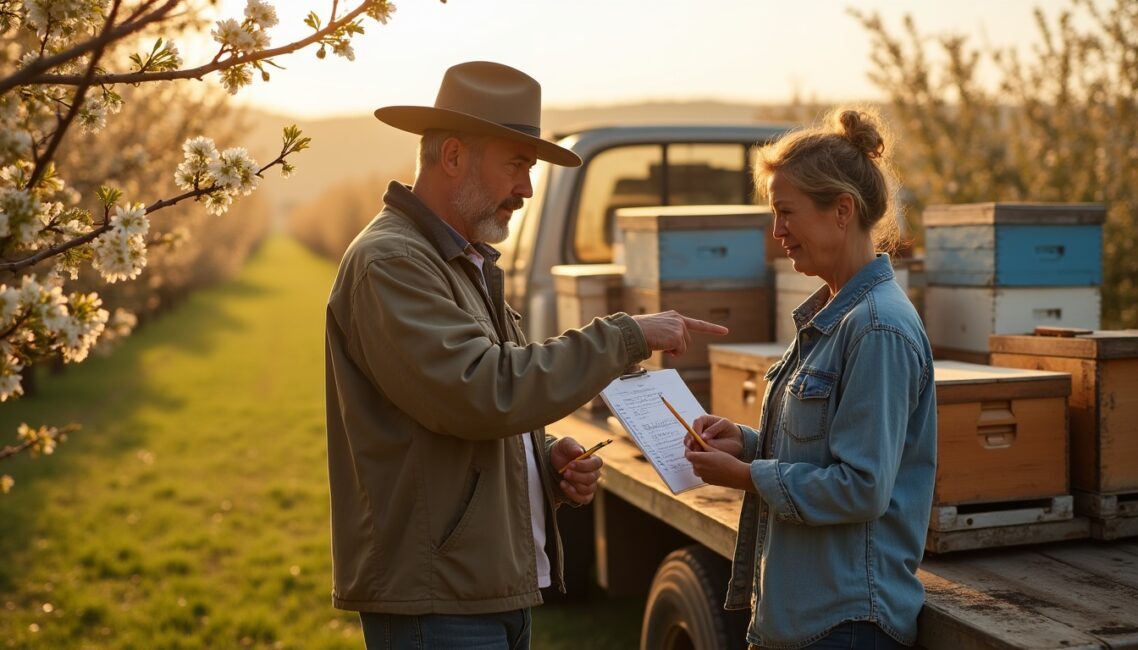
Compliance with apiary registration, movement permits and pesticide incident reporting are non negotiable elements that protect business continuity and client trust in pollination services, integrating legal risk mitigation into daily operations.
Securing appropriate liability and crop insurance clarifies responsibilities after damage events and can be a decisive factor for growers selecting a service provider, thus insurance increases marketability and reduces financial exposure during incidents.
Proactive engagement with extension services and adherence to local guidelines lowers inspection risk and enhances access to funding and research partnerships, which contribute to a robust and recognized service offering.
Anúncios
Site Selection, Forage Assessment and Logistics for Starting Apiary
Choosing apiary locations requires integrating floral resource mapping, landscape connectivity and pesticide exposure assessment to ensure sustained nectar and pollen flow while minimizing toxicant risks and transport time between contracts.
Floral Resource Mapping and Seasonal Phenology
Mapping bloom calendars and forage abundance identifies windows of resource abundance and scarcity, guiding colony placement and supplemental feeding strategies that maintain forager workforce during lean periods and peak demand.
Understanding spatial heterogeneity in floral sources and competition with wild pollinators allows optimization of apiary density and movement schedules, improving per colony performance and reducing over exploitation of resources.
Adopting remote sensing and local scouting techniques refines predictions of bloom timing and intensity, enabling timely relocation of hives to maximize pollination impact and revenue per service contract.
Transportation Planning and Hive Mobility
Logistics for delivering pollination services involves crate design, load balancing and route optimization to minimize colony stress and transit mortality, which directly influence service quality and client retention rates.
Transport timing relative to temperature and forage conditions reduces forager loss and brood chilling, while specialized trailers and secure fastening systems lower mechanical damage, thereby preserving colony strength and profitability.
Investment in modular transport units and scheduling software reduces turnaround times between sites, increasing the number of contracts a single operation can fulfill during concentrated bloom windows and raising revenue potential.
Site Biosecurity and Neighbor Conflict Mitigation
Establishing buffer zones and communication protocols with neighboring land users decreases pesticide exposure and vandalism risks, essential practices that increase colony survival and the reliability of pollination deliveries to growers.
Implementing entrance placement strategies and water provisioning reduces colony drift and competition, which stabilizes forager retention and minimizes pathogen spread between apiaries, improving overall system resilience.
Structured outreach and written agreements with landowners clarify responsibilities during agrochemical applications and access issues, reducing disputes and supporting long term site availability for recurring service relationships.
Hive Equipment, Genetics and Management Protocols
Selection of hive types, genetic stock and management rhythms defines operational efficiency and colony vigor, balancing ease of manipulation with thermal regulation and foraging capacity to meet the temporal precision demanded by pollination clients.
Hive Design and Material Choices
Choosing hive architecture influences airflow, brood nest stability and inspection speed, which impacts labor efficiency and colony survivorship during extreme weather, therefore selecting robust materials reduces replacement costs and interventions.
Insulation and entrance sizing support brood rearing and reduce robbing events, while standardized frames and tools speed up routine inspections and treatments, contributing to predictable service readiness during contract windows.
Modular systems that allow rapid expansion or consolidation of colonies improve responsiveness to fluctuating demand, giving managers flexibility to allocate resources to higher value contracts without compromising colony health.
Queen Selection, Breeding and Colony Strength Targets
Genetic choices for disease resistance, productivity and temperament reduce labor and treatment costs while influencing foraging intensity, all of which determine whether a colony meets defined strength targets for pollination guarantees.
Establishing performance metrics such as frame counts and forager return rates provides objective criteria for queen replacement and splitting decisions, which improves forecast accuracy for available service units during consecutive bloom events.
Integrating controlled breeding or sourcing from reputable suppliers decreases incidence of inferior traits and aligns colony behavior with management protocols, improving long term service reliability and client satisfaction.
Integrated Pest Management and Sanitary Routines
Regular monitoring and threshold based interventions for varroa and pathogens are critical to maintain endpoint colony strength, reducing unexpected losses and maintaining contractual obligations to growers when pollination is required.
Alternating chemical and mechanical control methods delays resistance development and lowers treatment residues in hive products, supporting both colony health and market acceptance of honey and nucleus sales tied to service operations.
Record keeping for treatments and disease events enhances traceability and supports proactive decisions about quarantine and remedial actions, which protect the asset base and secure trust with commercial clients.
Anúncios
Financial Modeling, Pricing and Contract Design
Robust financial models convert biological and logistical variables into pricing structures that cover fixed and variable costs while offering competitive rates, enabling sustainable growth and predictable margins for pollination services.
Developing Unit Economics Per Colony and Per Contract
Calculating per colony costs including depreciation, labor and consumables allows precise bidding on pollination contracts, preventing underpricing and ensuring each engagement contributes positively to overhead recovery.
Scenario analysis that models colony loss rates and variable bloom lengths highlights sensitivity to key assumptions, guiding contingency reserves and flexible contract clauses to mitigate revenue volatility.
Transparent cost breakdowns increase credibility with growers and support dynamic pricing during high demand periods, allowing operators to capture value while still delivering measurable pollination outcomes.
Contract Clauses, Timing and Performance Metrics
Contracts that specify service windows, colony count and contingency remedies align expectations and reduce disputes, supporting long term partnerships where both parties share risk and benefit from reliable pollination results.
Incorporating clauses for adverse weather, pesticide damage and colony loss provides predictable remediation pathways and clarifies responsibilities, which reduces litigation risk and supports operational resilience.
Using measurable performance indicators such as bloom coverage and hive visitation rates creates objective bases for evaluating service fulfillment and enables data driven adjustments to future pricing and deployment strategies.
Funding, Grants and Government Resources
Public funding and extension resources can offset startup costs and provide technical support, reducing financial barriers and accelerating adoption of best practices that increase competitiveness in the pollination services market.
Leveraging collaborative programs with universities and agricultural agencies builds credibility and can unlock research partnerships that improve management efficiency and inform evidence based service offerings to growers.
Access to low interest loans and cost share programs increases capacity to invest in transport and biosecurity infrastructure, which enhances service reliability and long term return on capital for the operation.
Operational Scaling, Workforce and Quality Assurance
Scaling an apiary involves synchronized growth of colonies, trained staff and quality systems that preserve service consistency while expanding geographic reach, thereby converting technical capacity into reliable commercial throughput.
Workforce Training and Standard Operating Procedures
Investing in technician training for inspections, safe handling and transport reduces error rates and colony stress, which improves survival and the predictability of pollination outcomes across multiple sites and seasons.
Standard operating procedures for routine tasks create uniform quality and simplify onboarding of seasonal labor, minimizing variability in service delivery and strengthening the brand reputation among agricultural clients.
Continuous improvement cycles based on field data refine protocols and reduce inefficiencies, leading to lower per contract costs and enabling sustainable scaling without compromising colony health or client expectations.
Quality Assurance and Client Reporting
Documenting hive strength metrics and providing growers with observational reports enhances transparency and allows agronomic adjustments that optimize pollination returns, creating measurable value that supports premium pricing.
Using photographic evidence and quantified metrics such as frames of bees and forager counts substantiates claims about service performance, reducing disputes and building long term trust with commercial partners.
Quality assurance frameworks that incorporate client feedback and post service evaluations drive incremental improvements and inform strategic decisions about where to expand or concentrate service offerings.
Expansion Strategies and Partnership Models
Strategic alliances with input suppliers, transport firms and growers reduce capital burden and allow flexible expansion into new crops and regions, increasing revenue diversification without proportionally increasing fixed costs.
Service franchising or cooperative models distribute operational risk while leveraging local expertise, enabling rapid geographic growth and improved response to regional demand peaks for pollination services.
Careful selection of partnership terms that align incentives around colony health and pollination outcomes ensures sustainable collaborations that preserve bee welfare and long term profitability.
Risk Management, Biosecurity and Environmental Stewardship
Risk mitigation integrates biosecurity protocols, emergency response and landscape stewardship to protect colonies and landscape services, balancing commercial objectives with ecosystem health and regulatory expectations.
Biosecurity Protocols and Disease Containment
Implementing entrance hygiene, equipment sterilization and movement controls reduces pathogen transmission between sites, protecting asset value and preventing cascading failures that undermine service reliability.
Rapid diagnostic workflows and quarantine rules reduce time to intervention for suspected disease events, limiting colony mortality and preserving the operational base for delivering contracted pollination services.
Embedding biosecurity into daily routines and training sustains low infection prevalence and enhances the perception of professionalism that many growers require when selecting service providers.
Environmental Compliance and Pesticide Exposure Mitigation
Mapping pesticide application schedules and engaging growers on integrated pest management practices reduces acute colony losses and supports coexistence, which protects business continuity and ecological service provision.
Documenting exposure incidents and collaborating on remediation increases accountability and can lead to improved practices that sustain pollination services and reduce legal and reputational risks.
O Que Evitar
Underinsuring the operation which amplifies financial impact from colony losses and liability claims.
Neglecting varroa monitoring that leads to rapid declines in colony strength during high demand periods.
Overcommitting colonies to simultaneous contracts which results in service failures and damaged reputation.
Avoidance of these common errors preserves operational stability and protects revenue streams, guiding managers toward preventative investments and conservative growth strategies that sustain long term service delivery.
Monitoring, Data and Continuous Improvement for Starting Apiary
Data driven monitoring integrates hive inspections, environmental sensors and service outcomes to refine management decisions, improving allocation of colonies and enhancing predictability of pollination performance across contracts and seasons.
Key Performance Indicators and Sensing Technologies
Indicators such as frames of bees, brood area and in hive temperature profiles provide objective measures of colony readiness and can be augmented by weight and acoustic sensors that detect early decline signatures and inform interventions.
Adopting low cost sensors and routine scoring protocols allows aggregation of time series data that reveal trends in health and productivity, enabling managers to prioritize resources and respond before critical failures occur.
Analytics that combine environmental and hive data improve forecasting of service availability and support evidence based pricing that reflects actual capacity and risk adjusted performance potential.
Data Management and Decision Support
Centralized records of movements, treatments and service outcomes create a knowledge base that improves repeatability and reduces decision latency, which supports consistent service quality and operational scaling.
Decision support tools that synthesize historical performance and current hive conditions enable rapid redeployment of colonies to high value contracts, improving revenue capture and reducing idle capacity.
Maintaining data integrity and privacy when sharing reports with clients and regulators strengthens credibility and facilitates collaborative problem solving around environmental or management challenges.
Continuous Improvement Cycles and R D Partnerships
Engaging with research institutions and extension services creates feedback loops that translate field experimentation into improved protocols and novel technologies that increase productivity and reduce treatment reliance.
Adopting iterative approaches to protocol refinement reduces waste and fosters innovation that differentiates the service offering in competitive markets while enhancing ecological resilience.
Operational Comparisons and Decision Matrices
Comparative analysis across hive types, transport strategies and contract forms clarifies trade offs and supports strategic choices that align capital allocation with target markets and growth trajectories.
Aspect
Standard Langstroth
Top Bar
Manipulation Speed
High with standardized frames
Lower due to comb handling
Transport Durability
Good for long hauls
Moderate for short moves
Cost per Hive
Moderate initial investment
Lower material costs
Evaluating these alternatives in light of labor availability and target crops informs equipment selection and long term capital planning, influencing both unit economics and service scalability.
Use of mobile trailers improves turnaround but increases capital needs and maintenance obligations.
Investment in queen breeding reduces replacement costs but requires specialized expertise and facilities.
Data systems raise upfront costs and provide critical returns through optimized deployment and reduced mortality.
Comparative metrics help prioritize investments that yield highest return on labor and capital while mitigating operational risk and improving the service proposition for growers.
Criteria
Small Scale Service
Large Commercial Fleet
Flexibility
High, can adapt quickly
Lower, requires planning
Per Contract Cost
Higher due to fixed overhead
Lower with economies of scale
Risk Exposure
Concentrated on few clients
Distributed across many contracts
Selecting a model depends on market access and management capacity, choices that shape the long term resilience and profitability of the pollination service enterprise.
Begin Operationalizing Your Plan and Next Steps
Translating strategy into action focuses on pilot contracts, phased investments and establishing governance for biosecurity and quality control, which together create a repeatable engine for growth and reputation in the pollination market.
Start with small pilot contracts to validate pricing and logistics before scaling rapidly across regions.
Prioritize training and SOP development to maintain consistent service quality as the operation grows.
Document outcomes and client feedback to refine offers and differentiate the service proposition.
Early pilots reduce uncertainty and provide empirical data to refine models, enabling operators to scale with confidence while safeguarding colony health and client relationships.
Engage accredited sources to support best practices and funding opportunities through reliable channels, for example the United States Department of Agriculture guidance and university extension materials that offer validated protocols
For updated research and market insights consult regional extension services and agricultural portals such as the USDA resource center and university extension pages that provide technical references and program information
Start Today: Apply the Knowledge and Move Forward
Adopt a phased approach that balances conservative investment with targeted innovations, ensuring that each decision strengthens colony health, operational resilience and client value, which sets a sustainable trajectory for growth in pollination services.
Prioritize measurable steps that improve predictability and protect assets while fostering partnerships that expand market access, this pragmatic stance accelerates impact and builds the credibility necessary for a thriving commercial apiary.
FAQ
How Much Does It Typically Cost to Start an Apiary Suitable for Pollination Services
Startup costs vary by scale and region with key drivers being hives, transport and colony purchase, I recommend budgeting for durable hives, a reliable transport solution and contingency funds for disease events, initial estimates for a modest commercial operation often range from moderate to significant amounts but careful budgeting and phased growth reduce financial strain and support sustainable scaling.
What Are the Critical Timing Considerations When Offering Pollination Services
Timing aligns colony strength with crop bloom and requires forecasting floral phenology, reliable transport and contingency plans for weather disruptions, synchronization of these elements ensures colonies deliver peak forager activity during bloom windows which directly impacts pollination efficacy and client satisfaction.
How Should I Price Pollination Contracts to Be Competitive and Sustainable
Price based on unit economics that include amortized capital, variable costs and risk premiums for colony loss and travel, transparent cost models improve negotiations with growers and allow dynamic pricing during high demand, this approach preserves margins while delivering predictable service quality.
Which Biosecurity Practices Are Most Effective for Preventing Disease Spread Between Apiaries
Effective measures include equipment sterilization, movement logs and quarantine for new colonies coupled with routine varroa monitoring and threshold based treatments, integrating these practices reduces pathogen transmission and preserves the operational base needed to meet contractual obligations.
Where Can I Find Authoritative Guidance and Support for Starting an Apiary
Authoritative guidance is available from government and academic extension services which provide practical protocols and regulatory information, engaging with these institutions enhances technical capacity and access to funding and research collaborations that support evidence based management and service delivery.
Edvânia Almeida. Formada em Ciências Contábeis e Pós-graduada em Gestão Financeira: Auditoria e Controladoria pela FGV. Pequena pecuarista e apaixonada pelo Agronegócio e Gestão Estratégica.
Para fornecer as melhores experiências, usamos tecnologias como cookies para armazenar e/ou acessar informações do dispositivo. O consentimento para essas tecnologias nos permitirá processar dados como comportamento de navegação ou IDs exclusivos neste site. Não consentir ou retirar o consentimento pode afetar negativamente certos recursos e funções.
Funcional
Sempre ativo
O armazenamento ou acesso técnico é estritamente necessário para a finalidade legítima de permitir a utilização de um serviço específico explicitamente solicitado pelo assinante ou utilizador, ou com a finalidade exclusiva de efetuar a transmissão de uma comunicação através de uma rede de comunicações eletrónicas.
Preferências
O armazenamento ou acesso técnico é necessário para o propósito legítimo de armazenar preferências que não são solicitadas pelo assinante ou usuário.
Estatísticas
O armazenamento ou acesso técnico que é usado exclusivamente para fins estatísticos.O armazenamento técnico ou acesso que é usado exclusivamente para fins estatísticos anônimos. Sem uma intimação, conformidade voluntária por parte de seu provedor de serviços de Internet ou registros adicionais de terceiros, as informações armazenadas ou recuperadas apenas para esse fim geralmente não podem ser usadas para identificá-lo.
Marketing
O armazenamento ou acesso técnico é necessário para criar perfis de usuário para enviar publicidade ou para rastrear o usuário em um site ou em vários sites para fins de marketing semelhantes.
 Ir para o conteúdo