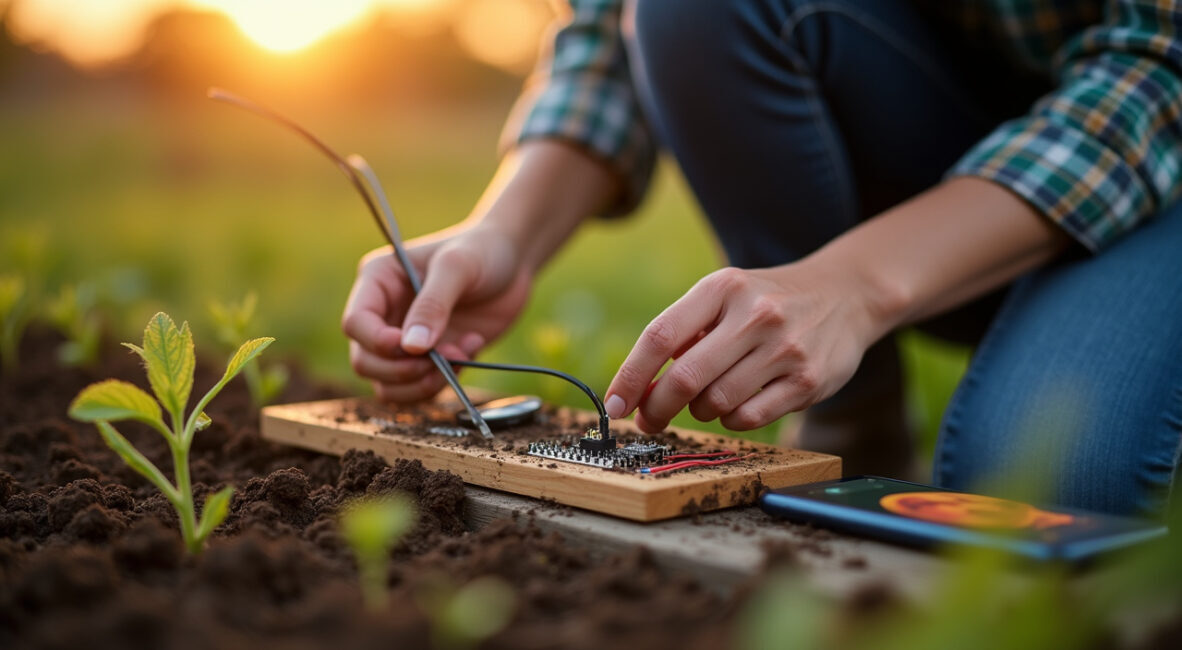
DIY solutions for soil moisture sensing let farmers and gardeners build affordable sensors to monitor irrigation needs accurately. This approach reduces water waste, improves crop health, and enables precision watering by using simple electronics and open-source integration.
Many farms face overwatering or inefficient schedules; low-cost DIY solutions offer a practical path to continuous soil moisture monitoring. With basic components, wiring, calibration tips, and app integration, you can automate irrigation so you water only when crops actually need it.
In this guide you’ll find complete parts lists, step-by-step wiring, calibration procedures, and methods to send readings to farm apps and dashboards. Follow these DIY solutions to build reliable, cost-effective sensors tailored to your operation.
Soil moisture sensors commonly measure either volumetric water content or soil electrical properties; resistive probes sense conductivity while capacitive sensors measure dielectric permittivity. Choosing the right sensor depends on soil type, longevity needs, and budget constraints.
Resistive probes are cheap but prone to corrosion; capacitive designs last longer and give more stable readings. Both are widely used in DIY solutions for small farms, gardens, and research plots because they balance cost and performance.
When planning a build, consider sensor durability, calibration requirements, and the data interface you need to integrate with irrigation controllers or farm management apps for effective precision irrigation.
Key Components Explained
Main components include a microcontroller (like ESP32 or Arduino), a moisture probe (capacitive or resistive), power supply, and optional temperature sensor. Each part affects accuracy, deployment length, and maintenance frequency.
The microcontroller handles ADC readings, filtering, and connectivity for transmitting data to apps. A stable power source, often 3.3–5V, and a regulator or battery management system are crucial for field reliability in DIY solutions.
Add-ons like waterproof enclosures, signal conditioning circuits, and low-pass filters enhance longevity and reading stability. Selecting components with agricultural-grade robustness reduces downtime and maintenance costs.
Anúncios
Where to Deploy Sensors on a Farm
Strategic placement uses sensor zoning: group sensors by soil type, crop root depth, and irrigation zones. Place probes at representative spots within each zone to capture moisture variability across fields or greenhouse beds.
For row crops, install sensors at root-zone depth (typically 10–30 cm). For potted plants or high-value crops, multiple depths improve irrigation control. Deployment planning is part of actionable DIY solutions for optimal water use efficiency.
Map sensor locations and document installation conditions; recording soil type and planting dates helps interpret readings and refine irrigation scheduling over seasons.
Anúncios
Affordable DIY Solutions for Building Sensors
Essential Parts List for a Low-cost Build
ESP32 or Arduino Nano (microcontroller with Wi‑Fi)
Capacitive soil moisture sensor probe (recommended) or resistive probe
Voltage regulator or battery holder (3.3V/5V)
Jumper wires, waterproof connectors, and shrink tubing
These baseline items form the backbone of many DIY solutions, combining connectivity and sensing in a minimal budget. The ESP32 offers Wi‑Fi for direct cloud integration while Arduino provides simplicity for local logging.
Investing in capacitive probes and waterproofing materials yields longer-term savings by reducing replacements and false readings, a common issue with cheaper resistive probes in agricultural soil conditions.
Optional Parts to Improve Robustness
Add a temperature and humidity sensor, SD card module for local logging, or a real-time clock for timestamped data. A small solar panel with LiPo battery and charge controller supports off-grid deployments and reduces maintenance visits.
A signal conditioning board (op amp or RC filter) stabilizes ADC readings, and an enclosure with IP65+ rating protects electronics from moisture. Use stainless steel or coated probe housings to diminish corrosion risks.
Choosing higher-quality connectors and cable glands for buried or exposed installations improves uptime and is a recommended investment in reliable DIY solutions for farms and gardens.
Cost Breakdown and Sourcing Tips
Typical material costs range from $15–$60 per sensor depending on components: microcontroller (~$5–$10), probe (~$3–$25), power components (~$5–$15), enclosure and wiring (~$2–$10). Bulk sourcing reduces per-unit cost considerably.
Buy capacitive probes and ESP32 boards from reputable suppliers to ensure consistent specs. Local electronics stores, online marketplaces, and agriculture suppliers all supply parts; verify shipping and return policies when sourcing internationally.
Maintain spare probes and consumables on hand; planning for part replacements reduces downtime and supports continuous monitoring using DIY solutions that scale across your operation.
Connect the probe output to an analog input (ADC) on the ESP32, with VCC to 3.3V and GND to ground. Use a voltage divider if the probe expects a different reference voltage to keep ADC readings within safe limits.
Place decoupling capacitors across VCC and GND to smooth supply noise; add a small RC filter on the signal line to reduce spikes caused by irrigation pumps or nearby motors. Secure all connections with solder or waterproof crimp connectors.
Use breadboards for prototyping but move to soldered perf board or PCB for field units. Label wires and follow a consistent color code to simplify future troubleshooting and maintenance of DIY solutions.
Designing Weatherproof Enclosures
Choose an IP65+ enclosure sized for batteries, microcontroller, and wiring. Use cable glands to seal cable entries and pot internal electronics with non-conductive foam or mounting brackets to prevent movement. Vent moisture using breathable waterproof membranes if necessary.
Avoid placing probes and electronics in the same enclosure to prevent moisture migration; run short, sealed cables to external probes. Consider a removable lid with gasket and stainless hardware for durability in farm environments.
Label enclosures with sensor ID and installation date. Proper enclosure design reduces corrosion and electrical failures, key goals of long-term DIY solutions on farms and gardens.
Powering Sensors: Batteries Vs. Solar
For stationary sensors, primary batteries offer simplicity but require periodic replacement. Rechargeable LiPo with a small solar panel and a charge controller delivers autonomous operation, reducing labor in remote deployments of DIY solutions.
Estimate average power draw from Wi‑Fi transmissions and sleeping intervals; optimize firmware to deep-sleep between measurements and batch transmissions to save energy. Use a power budget calculator to size batteries and solar panels correctly.
Implement brown-out detection and low-voltage cutoffs to protect batteries. Proper power management ensures reliable uptime across seasons and minimizes field visits for maintenance.
Anúncios
Calibration and Accuracy Techniques
Simple Calibration Steps for Field Use
Calibrate sensors using three reference points: dry (oven-dried soil), field capacity (saturated then drained), and an intermediate moisture level. Record ADC values at each point to build a calibration curve converting raw readings to volumetric water content.
Document soil texture and organic matter during calibration because calibration curves vary by soil type. Use container tests or cups for repeatable comparisons and avoid taking calibration only from one sample location.
Apply linear or polynomial fits depending on data behavior; store coefficients on the microcontroller or in companion software so each sensor reports standardized moisture units across your farm as part of practical DIY solutions.
Reducing Noise and Improving Repeatability
Filter readings in firmware by averaging multiple samples and discarding outliers. Use a median filter for transient spikes and a moving average for smoother trends. Hardware filtering with RC networks also reduces electromagnetic interference from pumps or tractors.
Ensure consistent probe insertion depth and orientation, and avoid placing probes next to rocks or very wet spots that bias results. Periodic re-calibration after heavy tillage or seasonal changes maintains accuracy for long-term DIY solutions.
Log raw values for a week after installation to identify systematic drift or anomalies before relying on automated irrigation decisions. This short validation period prevents misapplication of water across crops.
Validation Against Reference Instruments
Method
Use Case
Notes
Gravimetric soil test
High accuracy lab reference
Best for initial calibration across soil types
Commercial moisture meter
On-farm spot checks
Quick validation of sensor trend
Tensiometer
Root-zone tension monitoring
Useful for irrigated high-value crops
Compare your DIY sensor readings to gravimetric lab results or trusted commercial meters periodically. Differences reveal calibration adjustments or hardware issues that need correction to maintain reliable irrigation control.
Document comparisons over time and update calibration curves seasonally. Consistent validation ensures DIY solutions provide actionable data for farmers and gardeners making irrigation decisions.
Data Handling: Connectivity and Farm App Integration
Local Vs. Cloud Data Strategies
Decide whether to log data locally on SD cards or send it to the cloud. Local logging ensures data retention during connectivity outages but requires periodic collection; cloud transmission enables remote monitoring and integration with farm apps for automated irrigation control.
Hybrid strategies buffer data locally and sync when connectivity returns; this is common in remote agricultural settings. Choose MQTT or HTTP(S) protocols depending on your chosen platform and security needs.
Ensure data timestamps, sensor IDs, and calibration metadata accompany readings so farm apps can interpret values correctly and trigger irrigation only when sensors indicate the crop needs water, implementing practical DIY solutions.
Use MQTT or REST APIs to publish moisture readings to farm management systems or automation platforms like Node-RED, OpenAg, or commercial controllers. Configure thresholds for automatic valve actuation or notify operators when manual intervention is required.
Translate calibrated moisture values into actionable triggers: soil moisture below X% starts irrigation for zone Y. Incorporate weather forecasts and evapotranspiration (ET) data to refine schedules and avoid unnecessary watering.
Test automation rules in monitoring mode before enabling actuated control to prevent overwatering or hardware conflicts. Well-configured integrations let DIY solutions directly reduce water use while protecting yields.
Recommended Data Formats and APIs
Format
When to Use
MQTT JSON
Low-latency, many-to-many device networks
HTTP POST JSON
Simple cloud endpoints and RESTful APIs
Standardize payload fields (sensor_id, timestamp, moisture_vwc, battery_voltage, temp_c) for compatibility with dashboards and analytics tools. Use secure connections (TLS) and API keys to protect data and control commands in field deployments.
Leverage existing farm platforms or cloud providers for visualization and rule engines; many offer free tiers for small-scale projects, making DIY solutions accessible and scalable.
Maintenance, Troubleshooting and Scaling
Routine Maintenance Checklist
Inspect probes for corrosion or buildup
Verify battery voltage and charge state
Check enclosure seals and cable glands
Regular maintenance extends sensor life and preserves reading quality. Schedule checks after extreme weather events, seasonal transitions, or major field operations to catch issues early and maintain consistent data for DIY solutions.
Keep a log of maintenance actions, component replacements, and firmware updates to track device histories and identify recurring faults that might indicate design improvements.
Common Troubleshooting Steps
If readings drift or become noisy, first inspect physical connections and probe placement. Replace corroded probes, clean contacts, and re-check calibration points. Verify power supply stability and review firmware logs for anomalous transmissions.
Network issues often cause data gaps; evaluate Wi‑Fi signal strength and consider low-power wide-area network (LPWAN) options like LoRaWAN for large fields. A watchdog timer and auto-reconnect logic in firmware help maintain uptime.
Document fixes and their outcomes to inform iterative improvements across units. Troubleshooting data helps refine deployment practices and component choices for durable DIY solutions at scale.
Scaling from Prototype to Multi-zone Systems
When expanding, standardize hardware, calibration methods, and network topology to simplify management. Use unique IDs and a central registry for sensors so your farm app can map readings to irrigation zones automatically and reliably.
Consider gateway devices to aggregate many sensors and use fieldbus or LoRaWAN for long-range, low-power communication. Centralized dashboards with alerting reduce the manual burden as sensor networks grow.
Plan logistics for spare inventories, firmware updates, and training of field staff to sustain operations. A documented deployment workflow makes scaling DIY solutions efficient across larger farms.
Cost-benefit and Environmental Impact of DIY Solutions
Economic Advantages for Smallholders
DIY solutions reduce per-sensor cost compared to commercial systems, enabling more widespread monitoring across small plots and greenhouses. Lower upfront costs accelerate payback via water savings and yield improvements.
By irrigating only when sensors indicate need, farms can reduce water bills, energy for pumping, and labor hours. Over a season, modest improvements in irrigation efficiency often offset hardware and setup expenses.
Consider lifecycle costs—including replacements and maintenance—to estimate true return on investment and justify up-front spending on higher-quality probes when appropriate for long-term savings.
Environmental and Resource Impacts
Optimized irrigation from sensor-driven decisions decreases water use and reduces nutrient leaching from overwatering. Precision irrigation also lowers greenhouse gas emissions associated with energy use for pumping and improves soil health by avoiding chronic saturation.
Deploying DIY solutions across many small farms can collectively conserve significant water volumes and promote resilient agriculture. Choosing durable components reduces e-waste and supports sustainable practices in the long term.
Document environmental benefits on-farm to support grant applications or sustainability certifications that can offset implementation costs and showcase stewardship of natural resources.
Case Study Examples and References
Small growers implementing DIY sensors reported reduced irrigation frequency and improved uniformity in soil moisture, translating to healthier crops and lower input costs. Field data often highlights the value of targeted watering based on sensor readings rather than time-based schedules.
For deeper research and standards, consult resources like the FAO for irrigation best practices and agricultural extension services for local soil guidance. These authoritative sources complement practical DIY solutions for agricultural settings.
See external resources for detailed calibration methods and local water management guidance to align your sensor deployment with best agricultural practices and regulatory recommendations.
DIY solutions for soil moisture sensors provide a cost-effective path to precision irrigation, improved yields, and better resource stewardship. Build, calibrate, and integrate these sensors to automate watering so crops receive water only when they actually need it.
Start with one zone, validate sensors against reference tests, and scale systematically. Implement the calibration and maintenance routines described above, and connect data to farm apps to realize continuous savings and smarter irrigation decisions.
FAQ
How Accurate Are DIY Soil Moisture Sensors Compared to Commercial Units?
DIY sensors can approach commercial accuracy when using capacitive probes, proper calibration, and signal conditioning. Field calibration to gravimetric reference points and routine validation help minimize drift. While cheap resistive probes often corrode and drift, a well-built DIY system with good enclosures and firmware filtering can deliver reliable moisture trends suitable for irrigation control, especially when combined with periodic recalibration and cross-checks against trusted meters.
What is the Best Microcontroller Choice for Remote Deployments?
The ESP32 is a strong choice for remote deployments due to built-in Wi‑Fi, low cost, and deep-sleep modes that conserve power. For long-range, low-power networks consider using an MCU paired with a LoRa module for larger fields. Balance connectivity options with power management; include watchdog timers, battery monitoring, and a solar charge system for autonomous operation in off-grid farm locations to ensure continuous DIY solutions.
How Often Should Sensors Be Calibrated in the Field?
Calibrate initially at installation with dry, field capacity, and intermediate points, then recheck seasonally or after major soil disturbance like tillage. High-salinity soils or changing organic matter may require more frequent recalibration. Regular spot checks against a gravimetric test or commercial meter help detect drift early and maintain effective irrigation control across your DIY solutions network.
Can I Integrate These Sensors with Commercial Farm Management Software?
Yes, most farm management platforms accept MQTT or HTTP(S) JSON payloads. Standardize payload fields and include calibration metadata so the platform interprets readings consistently. For platforms without native support, use middleware like Node-RED or a small cloud function to transform and forward sensor data. Secure API keys and TLS are recommended when integrating DIY solutions into production farm systems to protect control commands and telemetry.
What Are Common Failure Modes and How Do I Prevent Them?
Common failures include probe corrosion, power failures, and water ingress. Prevent them by using capacitive probes or coated metals, robust enclosures with proper cable glands, and good power management (solar with LiPo and low-voltage cutoffs). Implementing watchdogs, OTA firmware updates, and maintaining spare parts on hand reduces downtime and preserves data continuity for your DIY solutions in agricultural deployments.
Edvânia Almeida. Formada em Ciências Contábeis e Pós-graduada em Gestão Financeira: Auditoria e Controladoria pela FGV. Pequena pecuarista e apaixonada pelo Agronegócio e Gestão Estratégica.
Para fornecer as melhores experiências, usamos tecnologias como cookies para armazenar e/ou acessar informações do dispositivo. O consentimento para essas tecnologias nos permitirá processar dados como comportamento de navegação ou IDs exclusivos neste site. Não consentir ou retirar o consentimento pode afetar negativamente certos recursos e funções.
Funcional
Sempre ativo
O armazenamento ou acesso técnico é estritamente necessário para a finalidade legítima de permitir a utilização de um serviço específico explicitamente solicitado pelo assinante ou utilizador, ou com a finalidade exclusiva de efetuar a transmissão de uma comunicação através de uma rede de comunicações eletrónicas.
Preferências
O armazenamento ou acesso técnico é necessário para o propósito legítimo de armazenar preferências que não são solicitadas pelo assinante ou usuário.
Estatísticas
O armazenamento ou acesso técnico que é usado exclusivamente para fins estatísticos.O armazenamento técnico ou acesso que é usado exclusivamente para fins estatísticos anônimos. Sem uma intimação, conformidade voluntária por parte de seu provedor de serviços de Internet ou registros adicionais de terceiros, as informações armazenadas ou recuperadas apenas para esse fim geralmente não podem ser usadas para identificá-lo.
Marketing
O armazenamento ou acesso técnico é necessário para criar perfis de usuário para enviar publicidade ou para rastrear o usuário em um site ou em vários sites para fins de marketing semelhantes.
 Ir para o conteúdo