Vertical farming for small spaces is an efficient method to grow food in apartments, balconies, and sheds using stacked systems, compact racks, and targeted lighting. It matters because urban dwellers can produce fresh vegetables year-round, reduce food miles, and maximize productivity per square meter. To start, assess your usable footprint, light availability, and water access so you can design a modular, space-saving vertical garden.
Small spaces often face constraints like limited floor area, low ceilings, and variable sunlight, but clever vertical planning transforms these limitations into opportunities. Practical designs — including compact rack plans, modular trays, and integrated irrigation — allow growers to cultivate leafy greens, herbs, and compact fruiting crops with predictable yields. This article walks beginners through setups, components, crop choices, yield expectations, and performance-focused tips for small spaces.
Below you’ll find step-by-step setups, plans for racks and trays, lighting and irrigation hacks, crop suggestions with yield per square meter, comparative tables, and DIY guidance to build functional vertical farms in small spaces.
Stacked racks multiply planting area vertically, turning one square meter of floor into multiple cultivation layers. Use metal or wood shelving with adjustable shelving heights to accommodate different crop heights and lighting. A 4-tier rack can boost productive area while fitting on a balcony or utility room.
Consider weight-bearing capacity: saturated trays, water reservoirs, and fixtures add load, so choose sturdy materials. Integrate drip lines and a single reservoir line to each tier to simplify irrigation maintenance and reduce tubing clutter in compact environments.
Ventilation and access are essential in tight setups. Leave walkway clearance or design one-sided racks for balconies so each tray can be reached without moving multiple units. This improves plant care efficiency in small spaces.
Modular Tray Systems That Adapt to Available Space
Modular trays let you scale production incrementally: start with a few trays and add modules as confidence grows. Trays sized 30×60 cm fit most shelves and can be nested for storage. Modular systems are ideal for renters who need portable, non-permanent setups.
Use stackable clips and standardized tray heights so lighting and irrigation can be reused when expanding. Removable trays make crop rotation and deep cleaning simpler — important to avoid pest buildup in small, closed environments.
Modularity also supports mixed systems: hydroponic NFT strips on one module, soil/soilless trays on another. That flexibility helps growers optimize for different crops within the same compact footprint.
Anúncios
Vertical Towers and Living Walls for Balconies
Vertical towers and living walls maximize planting density on narrow balcony walls or shed interiors. Towers use cylindrical or hexagonal modules with integrated irrigation, offering 10–20 planting sites in a small vertical column. Living walls use pockets or planters hung in tiers.
Ensure irrigation is balanced — top-heavy watering can drown lower plants without proper drainage channels. Use capillary mats, drip emitters, or wick systems to maintain even moisture across levels in constrained setups.
Choose shallow-rooted crops for living walls and towers; basil, lettuce, and microgreens perform well. Towers can be rotated periodically to equalize light exposure in small spaces like balconies that receive directional sun.
Anúncios
Compact Systems for Small Spaces
Hydroponic Kits Ideal for Small Spaces
Countertop NFT trays for herbs
Compact deep-water culture for lettuce
Small ebb-and-flow modules with single pump
Reservoir-based aeroponic cylinders
All-in-one LED grow box for apartments
Hydroponic kits designed for small spaces remove soil, reduce mess, and often include compact reservoirs and pumps. They are water-efficient and can be placed on countertops, closets, or shelves. Choose a kit with a reliable pump and easy nutrient dosing to simplify management.
Pay attention to reservoir size vs. system volume: small reservoirs require more frequent water checks. For apartments, noise and odor are considerations; select quiet pumps and plan for occasional flushing to prevent buildup in confined spaces.
Soilless Tray Approaches for Rooftops and Sheds
Soilless media like coco coir, perlite mixes, or peat alternatives are lightweight and reduce pest risks in small sheds and rooftop boxes. Trays filled with soilless substrate are easier to manage and lighter for modular racks. They drain quickly and support consistent root aeration if mixed correctly.
Pair soilless trays with drip irrigation or wicking systems to maintain stable moisture without overwatering. For rooftop setups, secure trays against wind and choose UV-stable plastics or coated metals to prolong life in exposed small spaces.
Soilless approaches suit sensitive environments where soil contamination or lifting heavy loads is undesirable, particularly in urban small spaces where building rules may restrict loads and runoff.
Microgreens and herbs are high-value, fast-turnaround crops ideal for very small spaces; they need shallow trays and minimal vertical clearance. A single shelving unit with 4–6 tray positions can produce continuous harvests, offering quick yields per square meter.
Lighting and airflow are the main constraints: pair LED strips with timed cycles and gentle fans to prevent mold. Harvest cycles are short (1–3 weeks for many microgreens), enabling high turnover within compact footprints.
Because of quick cycles and small trays, microgreen operations are low-risk for beginners and allow experimentation with varieties before scaling to larger vertical systems in small spaces.
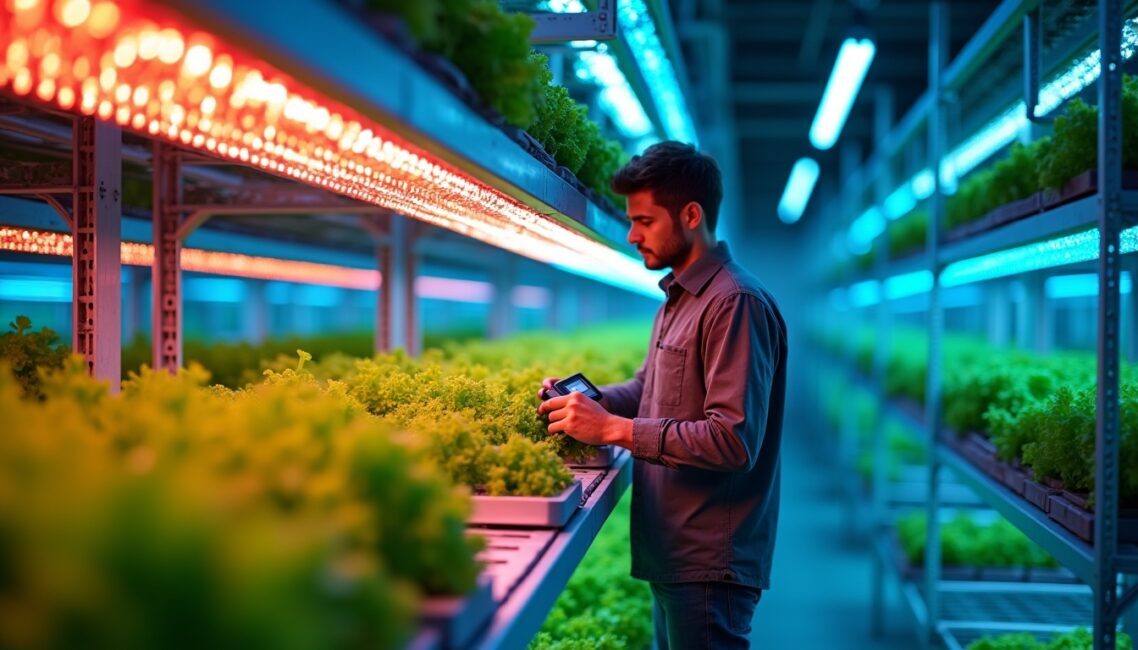
LED grow lights provide targeted spectra with low heat, fitting perfectly in tight vertical racks and balconies. Use full-spectrum LEDs or red/blue blends tuned for vegetative growth to reduce energy use and provide consistent PPFD across tiers. Mount lights adjustable in height to accommodate crop growth.
For energy efficiency, match light intensity to crop stage: seedlings need less PPFD than mature lettuce. Dimmable drivers and timers maintain consistent photoperiods while lowering electricity costs in small space farms.
Ensure fixtures have proper heat dissipation; compact spaces trap heat easily. Choose LEDs with integrated fans or passive heatsinks and monitor canopy temperatures to prevent stress in stacked setups.
Light Placement and Reflectivity Hacks
Reflective surfaces (mylar or white paint) on side walls amplify light distribution and reduce shadowing in compact racks. Place lights centrally or at the front of tiers, and use angled reflectors to reach lower plants in tall stacks. This increases uniformity without adding more fixtures.
Consider strip LEDs along the undersides of each shelf to deliver even illumination to lower trays. In balconies, combine natural sunlight with supplemental LEDs on cloudy days to maintain steady growth in small spaces.
Portable reflectors and foldable light panels are useful for renters who need temporary setups, enabling improved light efficacy without permanent installation in small spaces.
Energy-saving Schedules and Timers
Automate photoperiods with programmable timers to reduce manual intervention and save energy. For most leafy greens, 12–16 hours of light per day is sufficient; adjust for herbs and fruiting crops that may need longer or specific day/night cycles. Timers ensure consistency across stacked tiers.
Use solar timers or smart plugs to optimize use during off-peak electricity hours if available. In small spaces, syncing lights across tiers reduces power spikes and simplifies control.
Combine lighting schedules with nutrient dosing and irrigation cycles for integrated automation, improving reliability when managing vertical farms in compact environments.
Anúncios
Irrigation and Fertigation for Small Spaces
Drip Irrigation Hacks for Compact Racks
Drip irrigation with a single small pump and manifold distributes water precisely to each tray and saves water in small spaces. Use pressure-compensating drippers or micro-sprayers to ensure even flow across tiers despite elevation differences. Secure tubing to keep aisles tidy in tight areas.
Auto-fill float valves or reservoir sensors reduce manual refills in apartment setups. Place filters at the pump inlet to prevent emitter clogging from nutrients or particulates in small systems.
Schedule short, frequent irrigations to prevent saturation and root rot in small, stacked trays. This optimizes oxygenation and supports fast-growing crops commonly cultivated in small spaces.
Wicking and Passive Systems for Low-maintenance Setups
Wicking systems use capillary action from a reservoir to maintain substrate moisture without pumps — great for balconies and sheds where electricity or noise is a concern. Use absorbent media (coco coir) and durable wicks sized to your tray volume to stabilize moisture.
Passive systems require careful reservoir sizing relative to plant density and temperature. Monitor moisture initially to calibrate wick thickness and reservoir depth for consistent performance in small spaces.
Passive solutions are low-cost and low-maintenance, ideal for beginners or those who travel, and integrate well with modular trays that can be removed for harvesting or cleaning.
Fertigation Tips and Nutrient Management
In hydroponic and soilless vertical systems, fertigation delivers dissolved nutrients directly to roots. Use EC and pH meters to maintain nutrient balance; target EC ranges vary by crop (salad greens lower, fruiting crops moderate). Regular measuring is crucial in small systems where concentrations change rapidly.
Perform reservoir changes weekly to avoid nutrient drift and microbial buildup. In small spaces, small reservoirs lead to faster EC swings, so frequent monitoring prevents deficiencies or toxicity and stabilizes yields per square meter.
Record dosing schedules and maintain a simple log to track plant responses. Consistent fertigation practices make vertical farms in confined areas more predictable and productive.
Choose crops that fit shallow trays and have high harvest value per area. Leafy greens and herbs are staples for small spaces due to short cycles and shallow roots. Dwarf and determinate varieties of fruiting plants are suitable when you have slightly more vertical clearance.
Rotate crops seasonally or by shelf to balance nutrient demands and light requirements. Mixing quick-turn microgreens with longer-cycle herbs enhances continuous harvests in constrained footprints.
Yield Expectations Per Square Meter
Yields vary by system and crop: microgreens can produce 2–6 kg per m² per month, lettuce in vertical hydroponic racks commonly yields 5–20 kg per m² per crop cycle (4–6 weeks), and herbs yield 1–3 kg per m² per month with frequent cut-and-come-again harvesting. Dwarf tomatoes produce lower per m² but offer higher value per fruit.
Expect higher productivity in well-managed hydroponic setups with controlled light and fertigation. Soil trays in limited light will yield less; optimize with supplemental LEDs and consistent irrigation to approach hydroponic productivity in small spaces.
Documenting yields per tray and adjusting density helps improve forecasts; small-space growers can refine spacing and harvest timing to maximize output per square meter over successive cycles.
Crop Scheduling and Succession Planting
Create overlapping schedules to keep harvests steady: sown microgreen trays every 7–10 days, lettuce staggered every 2–3 weeks, and herbs rotated as you harvest. Succession planting prevents downtime and spreads workload across the week in small-space setups.
Use a simple calendar or spreadsheet to track sowing dates, expected harvests, and reservoir maintenance. Color-code shelves or trays by crop stage to manage light and nutrient needs efficiently in compact vertical farms.
Succession planning increases annual yield per square meter by reducing fallow time and improving turnover rates — a key optimization for limited growing areas.
Materials, Costs and Build Plans for Small Spaces
Compact Rack Plan with Materials and Cost Estimates
Component
Approx. Cost (USD)
4-tier metal shelving
$80–$150
LED strips (4 x 40W)
$120–$200
Pump and reservoir (20–40 L)
$40–$90
Build a 4-tier rack with adjustable shelves for flexibility. Materials like galvanized shelving, stackable trays, and integrated LED strips are widely available and relatively low-cost. Assemble with basic tools, securing fixtures to prevent tipping in small living spaces.
Factor in recurring costs: nutrients, replacement filters, and light electricity. Initial setup costs vary based on automation level; basic passive systems are cheapest, while fully automated hydroponic racks cost more but save labor and often increase yields per square meter.
Modular Tray Dimensions and Assembly Guide
Standard modular tray dimensions (30×60 cm or 20×40 cm) allow efficient layout on shelves and fit most LED fixtures. Use food-safe plastics or coated trays, and design brackets for quick slide-in/out access. Drill standardized drainage holes and include removable catch trays to keep floors dry in small spaces.
Label trays for crop rotation and keep spare modules for quarantine when trying new varieties. Simple assembly requires cutting supports to match tray widths and screwing brackets for stability on rental balconies or sheds.
Consider transportability: modular trays should be light enough to move through doorways and up stairs, enabling flexible placement in apartments and temporary rentals, aligning with the needs of small spaces.
Comparison Table: DIY Vs. Commercial Systems
Feature
DIY Setup
Commercial Kit
Initial Cost
Lower
Higher
Customization
High
Limited
Support & Warranty
None
Included
DIY builds offer customization and lower upfront costs but require hands-on skills. Commercial systems streamline installation, often include warranties, and are easier for beginners. Choose based on budget, technical comfort, and the permanence of the installation in your small space.
For renters, modular commercial kits may offer non-invasive setups. For those comfortable with tools, a DIY rack tailored to your exact measurements can maximize usable space and reduce costs per productive square meter.
Maintenance, Pests and Performance Optimization in Small Spaces
Cleaning, Sanitation and Disease Prevention
Strict cleaning and sanitation prevent disease buildup in compact farms where pathogens spread quickly. Sterilize trays between cycles, clean reservoirs weekly, and use hydrogen peroxide or appropriate disinfectants for soilless systems. Remove dead foliage promptly to reduce humidity-driven mold.
Maintain good airflow with cyclic fans and monitor humidity to avoid fungal outbreaks in small spaces. Implement tray isolation for new plants to prevent introducing pests into the whole system.
Document sanitation procedures and schedule routine checks — small-space operations benefit disproportionately from preventive practices due to limited buffering capacity against infestations.
Pest Control Strategies Suited for Confined Areas
Use integrated pest management (IPM): sticky traps, beneficial insects in contained enclosures, and biological controls are preferable to broad-spectrum pesticides in small spaces. For indoor setups, predatory mites or parasitic wasps can be introduced carefully in quarantined modules.
Regularly inspect undersides of leaves and root zones where pests like fungus gnats or aphids hide. Prevent soil-borne pests by using sterile, soilless media and clean tools between uses to avoid cross-contamination in tight quarters.
For balconies, physical screens and companion planting can reduce pest pressure while minimizing chemical usage that may be problematic near living areas.
Monitoring, Sensors and Performance Tracking
Sensors for pH, EC, temperature, and humidity help maintain stable conditions in vertical farms. Small, affordable IoT sensors can log data to a smartphone, enabling timely adjustments across tiers. Use multi-parameter kits to reduce monitoring time in busy small-space operations.
Track yields per tray and input usage (nutrients, electricity) to calculate productivity per square meter and optimize cycles. Small spaces require tight control to achieve predictable outputs and minimize wasted inputs.
Automated alerts for pump failures or low reservoir levels are particularly valuable where access is limited or when growers are away, protecting plants in confined vertical setups.
Conclusion
Vertical farming for small spaces unlocks year-round, high-density production using stacked racks, modular trays, targeted lighting, and efficient irrigation. By selecting the right system, crops, and maintenance routines, urban growers can maximize yield per square meter while minimizing footprint and resource use.
Start small: prototype a single rack with herbs or microgreens, monitor performance, and scale modularly. Embrace experimentation, document results, and refine your vertical farm to suit your apartment, balcony, or shed — then enjoy fresh, homegrown produce and reduced food miles.
FAQ
What Crops Are Best for Vertical Farming in Small Spaces?
Leafy greens, herbs, microgreens, and dwarf fruiting varieties are ideal due to shallow roots and fast cycles. These crops fit shallow trays and stacked racks, giving high yield per square meter. They require less light and lower vertical clearance, making them perfect for balconies and apartments.
How Much Yield Can I Expect Per Square Meter in a Small Vertical Setup?
Yields vary: microgreens can produce 2–6 kg/m² monthly; hydroponic lettuce systems often yield 5–20 kg/m² per crop cycle. Performance depends on light, nutrients, and system efficiency. Track results to refine density and schedules for better productivity.
Do I Need Special Permits to Install Vertical Farms on Balconies or in Sheds?
Permitting depends on local building codes and HOA rules. Small, non-permanent racks and containers usually don’t require permits, but fixed installations affecting structure, water, or drainage might. Check local regulations and landlord/HOA policies before large setups.
What Are Low-cost Irrigation Options for Beginners in Small Spaces?
Wicking systems, gravity-fed drip lines, or a single small pump with a manifold are budget-friendly. Passive wicking suits low-maintenance growers, while a small pump-based drip system gives more control. Start simple and upgrade as you scale to several tiers or hydroponic setups.
How Do I Prevent Pests and Diseases in Compact Vertical Farms?
Use sterile media, clean trays between cycles, maintain airflow, and monitor humidity. Employ IPM: sticky traps, biological controls, and quarantine new plants. Regular inspection and hygiene are critical because pests spread quickly in confined vertical environments.
Meta Description (reference): Vertical farming for small spaces helps urban growers maximize yield per square meter with compact rack plans, modular trays, and irrigation hacks.
Edvânia Almeida. Formada em Ciências Contábeis e Pós-graduada em Gestão Financeira: Auditoria e Controladoria pela FGV. Pequena pecuarista e apaixonada pelo Agronegócio e Gestão Estratégica.
Para fornecer as melhores experiências, usamos tecnologias como cookies para armazenar e/ou acessar informações do dispositivo. O consentimento para essas tecnologias nos permitirá processar dados como comportamento de navegação ou IDs exclusivos neste site. Não consentir ou retirar o consentimento pode afetar negativamente certos recursos e funções.
Funcional
Sempre ativo
O armazenamento ou acesso técnico é estritamente necessário para a finalidade legítima de permitir a utilização de um serviço específico explicitamente solicitado pelo assinante ou utilizador, ou com a finalidade exclusiva de efetuar a transmissão de uma comunicação através de uma rede de comunicações eletrónicas.
Preferências
O armazenamento ou acesso técnico é necessário para o propósito legítimo de armazenar preferências que não são solicitadas pelo assinante ou usuário.
Estatísticas
O armazenamento ou acesso técnico que é usado exclusivamente para fins estatísticos.O armazenamento técnico ou acesso que é usado exclusivamente para fins estatísticos anônimos. Sem uma intimação, conformidade voluntária por parte de seu provedor de serviços de Internet ou registros adicionais de terceiros, as informações armazenadas ou recuperadas apenas para esse fim geralmente não podem ser usadas para identificá-lo.
Marketing
O armazenamento ou acesso técnico é necessário para criar perfis de usuário para enviar publicidade ou para rastrear o usuário em um site ou em vários sites para fins de marketing semelhantes.
 Ir para o conteúdo